
Quick Summary
With high water tables and tidal surges along the Hackensack River creating severe structural risks, prompt water damage restoration in Little Ferry is essential to prevent hidden mold and foundation decay. Floodline Restoration Co. delivers trusted local emergency response across Bergen County, offering 45-minute on-site arrival, advanced extraction, moisture mapping, and complete structural reconstruction. Readers will understand how to handle localized flood risks and can call Floodline Restoration Co.'s 24/7 emergency line for immediate 45-minute dispatch and a free visual inspection.
Water Damage Restoration in Little Ferry – Fast 24/7 Recovery
When you need emergency water damage restoration in Little Ferry, fast response times and thorough drying protocols make all the difference. Waiting for building materials to dry on their own often leads to secondary issues like hidden mold colonies, warped joists, and ruined subflooring. Because Little Ferry regularly experiences flooding along the tidal Hackensack River, groundwater saturation and tidal backflow present distinct challenges that standard surface-water cleanups never address.[1]
Professional restoration crews, such as Floodline Restoration Co., arrive equipped with commercial-grade water extraction tools, thermal imaging gear, and industrial dehumidifiers. Restoration teams generally focus on stabilizing the property, monitoring psychrometric drying data, and coordinating documentation with insurance providers to streamline the recovery process. See also Water Damage Restoration in Teaneck | 10% Off & Free Estimate | Same-Day Service.
Rapid Water Damage Response in Little Ferry
At a glance: Emergency water damage restoration in Little Ferry requires immediate water extraction, deep structural drying, antimicrobial treatment, and targeted repairs. With roughly 94% of the borough located within a Special Flood Hazard Area, high water tables along the Hackensack River demand specialized drying equipment to protect foundations, subfloors, and finished living spaces.[2]
Effective water restoration goes beyond simple vacuuming. Technicians work to stabilize properties affected by river backflow, burst pipes, water heater blowouts, and hydrostatic basement seepage. Every step aims to return framing and flooring to dry baselines established by IICRC industry standards.
Tidal surges along the Hackensack River present an ongoing vulnerability for Little Ferry and neighboring communities. Managing groundwater and tidal flooding requires heavy-duty extraction and deep dehumidification before microbial growth takes hold inside wall cavities.[3]
What Does Water Damage Restoration Cost in Little Ferry?
Need water damage restoration in Little Ferry?
We’re available now - call for a fast, free estimate.
Restoration costs depend heavily on the source of the water, how far the moisture traveled, and whether framing materials need replacement. While general industry averages for clean-water drying in a single room might range between $1,200 and $2,200, broader structural restoration after a severe storm or river backflow can range from $5,000 to $15,000 or more. Note: The pricing ranges below reflect general industry estimates and are not verified pricing specific to Little Ferry.[5]
In low-lying Bergen County neighborhoods, continuous hydrostatic pressure from saturated soil often extends the required drying time compared to simple indoor plumbing leaks, which can influence overall mitigation costs.
General Industry Price Estimates
The following figures represent general industry cost benchmarks rather than Little Ferry-verified quotes.
| Restoration Service | Clean Water (Cat 1) | Gray Water (Cat 2) | Black / Tidal Water (Cat 3) |
|---|---|---|---|
| Inspection & Moisture Assessment | $150 – $300 | $200 – $400 | $250 – $500 |
| Room Extraction & Structural Drying | $1,200 – $2,200 | $1,800 – $3,200 | $2,500 – $4,500 |
| Mold Remediation & Antimicrobial Wash | $1,500 – $2,800 | $2,000 – $4,200 | $3,000 – $6,000 |
| Sewage & Silt Decontamination | N/A | $2,000 – $4,500 | $4,000 – $10,000 |
| Complete Structural Reconstruction | $3,000 – $6,500 | $5,000 – $9,500 | $8,000 – $15,000+ |
Key Factors That Influence Your Final Restoration Estimate
Three primary variables shape the scope and final cost of any restoration project:
- Water Contamination Category: Supply line breaks involve clean water (Category 1), requiring straightforward extraction and drying. By contrast, tidal surges and storm runoffs from the Hackensack River carry mud, silt, and bio-contaminants (Category 3). During Superstorm Sandy, floodwaters south of Route 46 reached depths of three to four feet, requiring aggressive sanitization and porous material removal before rebuilding could begin.
- Groundwater Hydrology and Saturated Soils: Soil that stays saturated for extended periods exerts continuous pressure against basement footings, slowing down standard evaporation and requiring high-capacity dehumidification equipment.
- Insurance Claim Coordination: Direct insurance coordination is standard industry practice to reduce administrative burden, with specialists like Floodline Restoration Co. frequently managing claim details. Technicians typically supply adjusters with thermal imaging maps, moisture meter logs, and detailed scopes of work.
How Little Ferry’s High Water Table and Tidal Flooding Affect Basements and Subfloors
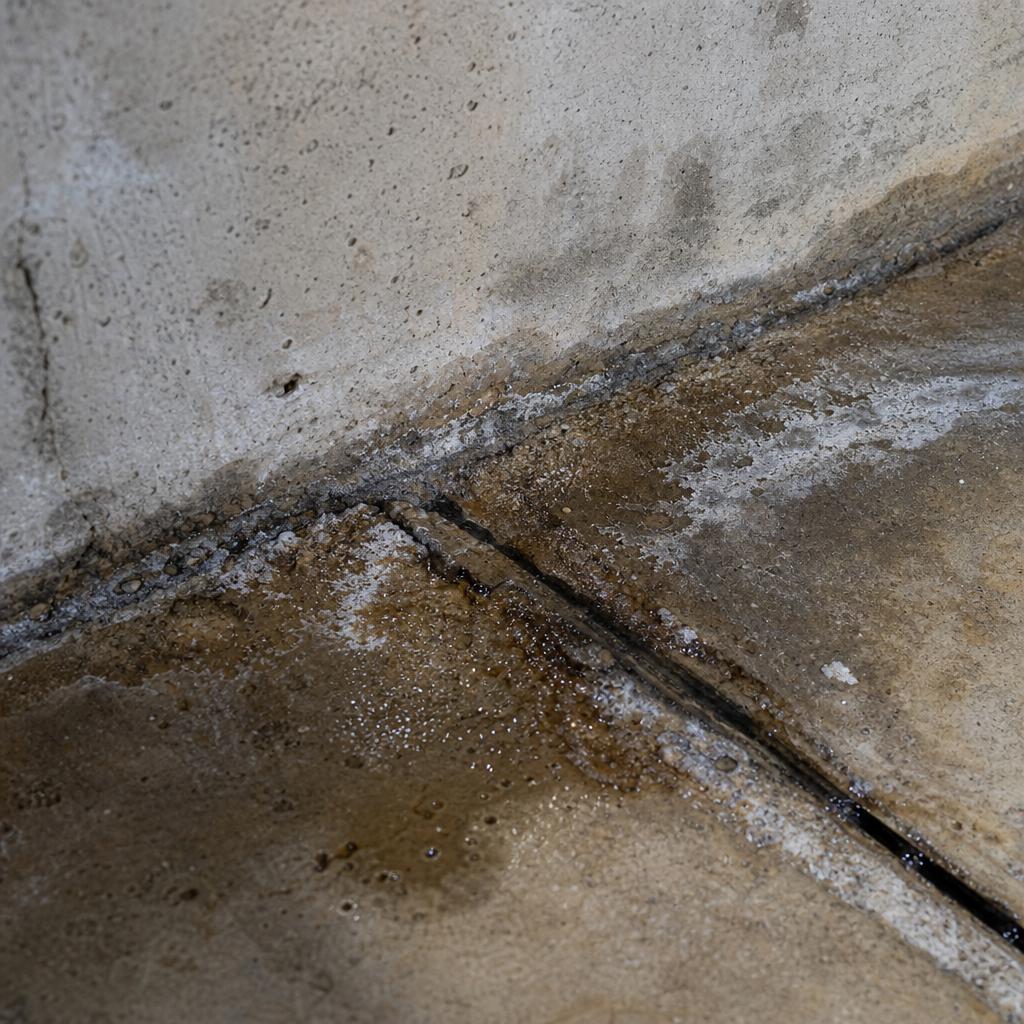
Because Little Ferry regularly experiences flooding along the tidal Hackensack River, hydrostatic pressure can develop against foundation walls and concrete slabs during high-water events. Saturated groundwater pushes through micro-fissures in masonry mortar and footing joints, soaking framing and subfloors from beneath. If left unmonitored, this trapped moisture leads to structural decay, musty odors, and rapid mold growth.[4]
Basement and Crawl Space Moisture Infiltration
Properties near the Losen Slote Creek watershed deal with rising groundwater whenever heavy rainfall coincides with high tide. Because river-driven intrusion picks up road runoff, silt, and contaminants, restoration technicians treat flood events as Category 3 water. Technicians use penetrating moisture meters and thermal cameras to locate hidden water migration routes through concrete slabs and foundation walls that appear completely dry to the naked eye.
Subfloor, Joists, and Hardwood Flooring Stabilization
When standing water reaches finished floors, restorers evaluate materials based on their structure and saturation level:
- Hardwood and Plywood Subfloors: If addressed within 24 to 48 hours, solid hardwood and plywood can often be saved. Technicians from Floodline Restoration Co. apply specialized floor mat drying systems that pull moisture vapor directly through the wood grain.
- Oriented Strand Board (OSB) and Laminate: These manufactured materials swell rapidly when exposed to standing water. Once edges expand and the glue fails, they generally require removal down to the joists.
- Dimensional Floor Joists: Solid wood joists are dense and can usually be saved in place with high-velocity air movers and dehumidifiers once wet insulation is cleared away.
Drywall, Ceilings, and Insulation: Repair vs. Replace Decisions
Drywall and insulation act like sponges, wicking moisture up wall cavities far above the visible waterline. Standard mitigation steps include:
- Flood Cuts: Cutting drywall neatly several inches above the highest moisture reading opens the wall cavity so framing can air out properly.
- Insulation Disposal: Saturated fiberglass and cellulose insulation lose their R-value and harbor bacteria. They must be removed and replaced.
- Antimicrobial Fogging: Exposed studs and sill plates are treated with registered botanical or hospital-grade antimicrobials to eliminate mold spores before replacement drywall is hung.
Step-by-Step Emergency Water Extraction and Restoration Process
Need water damage restoration in Little Ferry?
We’re available now - call for a fast, free estimate.
A dependable restoration plan follows four clear stages to take your property from active emergency back to a clean, stable condition:
-
Step 1: Emergency Assessment and Safety Containment
Technicians arrive on-site, shut down active electrical risks in wet areas, identify the source of the water, and set up containment barriers. This prevents airborne spores and dirty water from tracking into unaffected areas of your home or business.
-
Step 2: Rapid Extraction and Moisture Mapping
Using commercial extractors and submersible pumps, the crew pulls out standing water from basements, crawl spaces, and living areas. Technicians from Floodline Restoration Co. then map wet surfaces using moisture meters to determine drying goals for affected areas.
-
Step 3: Industrial Dehumidification and Structural Drying
Commercial air movers blow warm, dry air across floors and wall cavities, while commercial dehumidifiers pull moisture out of the air. Crews take routine psychrometric readings to track relative humidity and moisture levels in building materials.
-
Step 4: Sanitization, Mold Remediation, and Reconstruction
After deep cleaning with registered disinfectants, the space is prepared for rebuilding, including insulation replacement, drywall finishing, trim carpentry, and floor installation.
Frequently Asked Questions About Water Damage Restoration in Little Ferry
How quickly should emergency water damage restoration begin?
Emergency response should begin as soon as possible following water intrusion. Starting extraction and drying promptly helps prevent moisture from wicking deep into structural framing and limits secondary damage.
Does homeowners insurance cover flood damage and water restoration?
Standard homeowners insurance covers sudden internal water damage, such as a ruptured supply hose, frozen pipe, or water heater rupture. However, standard policies exclude rising river water, street runoff, and groundwater seepage. Those events require a separate flood insurance policy through the National Flood Insurance Program (NFIP) or private flood carriers. A professional restoration company like Floodline Restoration Co. will provide complete photographic documentation and dry-out logs to support whatever claim you file.
How do I prevent mold growth following water damage in my home?
Mold spores can germinate within 24 to 48 hours in damp environments. To stop growth, extract standing water immediately, lower indoor humidity below 50% using commercial dehumidifiers, discard wet porous items like carpet padding, and treat exposed lumber with an appropriate antimicrobial wash.
What emergency steps should I take while waiting for restoration technicians?
If it is completely safe to do so, follow these basic steps while waiting for help to arrive:
- Turn off the main water shut-off valve if the issue is a plumbing leak.
- Switch off circuit breakers to flooded areas only if you can reach the electrical panel without stepping in standing water.
- Move small furniture pieces, rugs, and valuables to dry areas or place aluminum foil under wooden furniture legs to prevent staining on carpets.
- Avoid using standard household vacuum cleaners, which are not designed for wet extraction and create an electrical hazard.
Need water damage restoration in Little Ferry?
We’re available now - call for a fast, free estimate.
Sources
- Moderate flood level scenarios-Synthetic storm-driven flood … – pubs.usgs.gov (2023)
- April 8, 2014 – nj.gov (2014)
- [PDF] ARCHIVED APRIL 2018 – Flood Insurance – agents.floodsmart.gov (2018)
- [PDF] FLOOD MITIGATION ENGINEERING RESOURCE CENTER (FMERC) – nj.gov (2013)
- [PDF] Strategies for Flood Risk Reduction for Vulnerable Coastal … – NJ.gov – nj.gov
Related reading: Water Damage Restoration in Hasbrouck Heights | Call Now-10% Off | Same-Day Service | Free Estimate
Related reading: Water Damage Restoration in Leonia – Call Now-10% Off – Same-Day Service – Free Estimate
Related reading: Water Damage Restoration in Bergenfield – Call Now-10% Off – Same-Day Service – Free Estimate
Water Damage Restoration in Nearby Cities
We also serve the communities around Little Ferry:
- Water Damage Restoration in Englewood
- Water Damage Restoration in Fort Lee
- Water Damage Restoration in Hackensack
Frequently Asked Questions
How long does structural drying take after river flooding or pipe bursts in Little Ferry?
Complete structural drying typically takes 3 to 5 days, though high groundwater tables along the Hackensack River can sometimes extend drying times. Floodline Restoration Co. uses commercial dehumidifiers and daily moisture mapping to ensure framing and subfloors reach safe baseline levels before rebuilding begins.
Can Floodline Restoration Co. handle structural repairs and rebuilding after water extraction?
Yes, Floodline Restoration Co. provides seamless all-in-one service, managing everything from initial water extraction and mold remediation to drywall replacement, subflooring, and full structural reconstruction. This comprehensive recovery approach eliminates the need to hire multiple contractors and simplifies the insurance claim process.
How quickly can emergency water restoration crews arrive at my Little Ferry property?
Floodline Restoration Co. delivers rapid 45-minute on-site arrival across Little Ferry and surrounding Bergen County communities. Calling our 24/7 live emergency line connects you immediately with local technicians ready to deploy commercial extraction equipment and provide a free visual inspection.
About the author
 |
Christopher Vance Christopher Vance brings over 12 years of hands-on experience in water mitigation and structural drying to the Floodline Restoration team. Holding IICRC certifications in Water Damage Restoration (WRT) and Applied Structural Drying (ASD), he specializes in rapid response strategies for Teaneck properties affected by severe water intrusion. His background in construction management from Rutgers University allows him to provide clear, actionable advice on minimizing secondary damage and navigating the restoration process. |
Water damage, flood, or mold emergency?
We’re available now - call for a fast, free estimate.
Call Now - Free Estimate