
Quick Summary
Property owners facing plumbing failures or severe weather require rapid water damage restoration in Fort Lee to prevent structural decay and hazardous mold growth across complex multi-family co-ops and residential basements. Floodline Restoration Co. delivers 24/7 emergency dispatch throughout Bergen County, utilizing advanced thermal imaging, specialized drying equipment, and direct insurance billing to streamline mitigation and reconstruction. Readers will understand how to properly stabilize water intrusions in diverse building layouts and can immediately contact Floodline Restoration Co. for rapid on-site inspections and comprehensive restoration.
Water Damage Restoration in Fort Lee
When a supply line snaps on the eighth floor of a high-rise co-op or an unexpected storm floods a finished basement, water moves fast. Emergency water damage restoration in Fort Lee works to stop the spread, extract standing water, and dry building materials before structural damage sets in.[4]
Properties perched on the Palisades and across Bergen County face distinct moisture challenges. According to the Bergen County Multi-Jurisdictional Hazard Mitigation Plan and local risk assessments, the county frequently deals with localized flash flooding and severe storms. Furthermore, New Jersey NOAA disaster summaries confirm that severe flooding remains a recurring billion-dollar weather disaster category for the state. When water penetrates a building, acting promptly with specialists like Floodline Restoration Co. is vital to protect structural framing, preserve hardwood, and prevent mold growth.[1] See also Water Damage Restoration in Teaneck | 10% Off & Free Estimate | Same-Day Service.
Rapid Response for Fort Lee Residential and Commercial Properties
Fort Lee features a dense mix of high-rise co-ops overlooking the Hudson River, commercial storefronts along Main Street, and mid-century split-level homes. Each building type responds differently to water intrusion:
- Multi-family co-ops and condos: A single pipe break in an upper unit often flows directly into shared vertical utility chases, draining behind walls across several floors before showing visible stains on ceilings below.
- Split-level and single-family houses: Water from a burst washing machine line or basement backup migrates horizontally beneath subflooring, traveling along joists and bridging across different floor elevations.
- Commercial facilities: Unchecked water causes swift business interruption, creating slip hazards and damaging inventory or electrical systems behind commercial drywall partitions.
Dispatch teams operate around the clock. Technicians arrive on-site with commercial-grade extraction units and diagnostic moisture equipment to stabilize the property immediately.
Why Standard Extraction Misses Hidden Moisture
Simply vacuuming water off the surface rarely solves the problem in Fort Lee’s complex multi-unit and split-level layouts. When water enters shared wall cavities, it bridges across drywall, insulation, and concrete slabs, remaining trapped long after the surface feels dry to the touch.
To identify the true perimeter of the moisture pocket without unnecessarily tearing out walls, certified technicians at Floodline Restoration Co. use precision diagnostic tools:
- Thermal Infrared Cameras: Infrared imaging detects the subtle evaporative cooling signatures left by hidden moisture pockets inside wall cavities and vertical plumbing chases.
- Calibrated Moisture Meters: Pin and pinless meters measure moisture levels deep inside subfloors, drywall, concrete slabs, and structural wall studs.
- Psychrometric Monitoring: Ambient temperature, relative humidity, and grains per pound (GPP) are continuously measured to maintain the exact drying environment needed for fast structural evaporation.
Restoration and Drying for Every Surface
Need water damage restoration in Fort Lee?
We’re available now - call for a fast, free estimate.
Different building materials require specific drying protocols to prevent permanent warping, delamination, and microbial growth.
Hardwood Floors and Subflooring
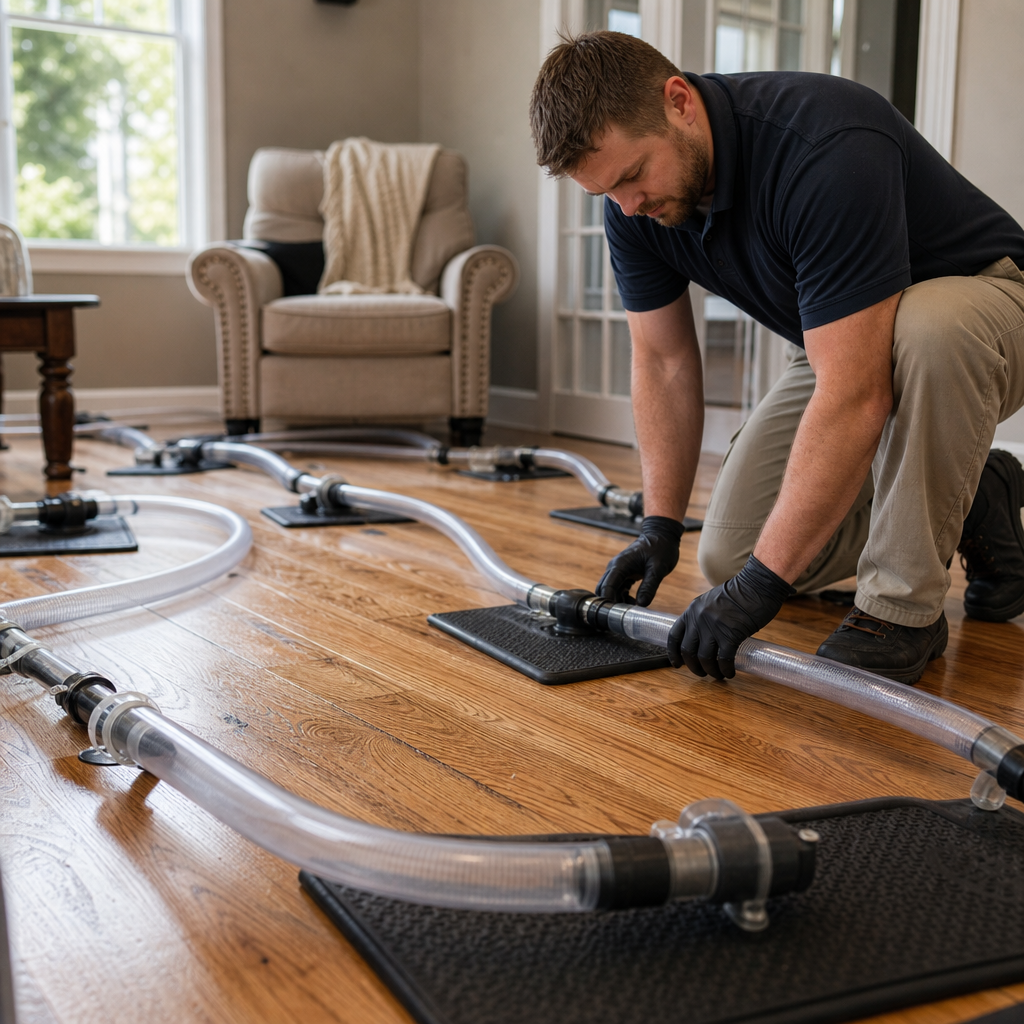
Hardwood absorbs standing water quickly, leading to cupping and crowning if neglected. Specialized negative-pressure floor mat systems can be placed directly over saturated planks. These mats pull moisture up through the wood fibers and subfloor without requiring full floor removal whenever mitigation begins promptly.[3]
Drywall, Ceilings, and Chases
In high-density apartment buildings, water pools on top of suspended drywall ceilings or seeps behind baseboards. Floodline Restoration Co. technicians track the migration path, perform non-destructive drying where possible, and make small, surgical openings only when necessary to circulate warm, dry air through damp wall cavities.
Basements and Crawl Spaces
Basements in low-lying sections of Bergen County are vulnerable to hydrostatic pressure and stormwater backups. FEMA flood hazard maps identify key floodplain zones across the county where heavy rains can overwhelm local drainage. Crews remove standing water, sanitize contaminated concrete and masonry surfaces, and run industrial LGR (low-grain refrigerant) dehumidifiers to pull moisture from porous foundations.[2]
Direct Insurance Billing and Documentation
Navigating an insurance claim while dealing with property damage is stressful. New Jersey homeowners insurance generally covers sudden and accidental water damage, but flood damage is excluded. Adjusters require thorough documentation of the loss to process claims efficiently.[5]
Restoration professionals at Floodline Restoration Co. document every phase of the mitigation process:
- Initial photo and video inventory of all affected structures and contents.
- Daily moisture logs and thermal imaging reports showing baseline readings and daily drying progress.
- Detailed, standardized industry estimates (Xactimate) mapped directly to policy requirements.
- Direct communication with the insurance adjuster to streamline claim processing.
From water extraction and structural drying to complete drywall repair, flooring replacement, and painting, full-service mitigation addresses the entire restoration process from start to finish.
Frequently Asked Questions
How quickly can an emergency water damage crew arrive in Fort Lee?
Emergency crews should be contacted immediately when water damage occurs. Response vehicles are equipped for prompt extraction, sanitation, and drying.
How much does water damage restoration cost in Fort Lee, NJ?
The total cost depends on the category of water (clean supply line, gray water from an appliance, or black water from a sewage backup), the volume of water, affected square footage, and structural accessibility. New Jersey homeowners insurance generally covers sudden and accidental water damage, but flood damage is excluded.
How long does the structural drying process take?
The duration of the drying process depends on the extent of water intrusion and the specific materials affected. Dense materials such as hardwood flooring, plaster, and concrete foundation walls often take longer to dry. Floodline Restoration Co. technicians verify that materials have returned to their natural dry standard using moisture meters before removing equipment.
How do you prevent mold growth after a flood or leak?
Microbial growth is mitigated by extracting water immediately, applying EPA-registered antimicrobial treatments to structural elements, and maintaining low relative humidity levels with commercial dehumidifiers and high-velocity air movers.
What steps should I take while waiting for the restoration crew?
If it is safe to do so, shut off the main water supply valve to stop the source of the leak. Turn off electricity to affected rooms at the breaker panel, avoid walking through standing water, and remove small valuable items or rugs from wet floors. Do not use a household vacuum cleaner to pick up standing water.
Need water damage restoration in Fort Lee?
We’re available now - call for a fast, free estimate.
Sources
- 4.0 RISK ASSESSMENT – bergencountynj.gov (2024)
- RAYMOND Strauss et al. (2014). New Jersey and the Surging Sea: A Vulnerability Assessment with Projections for Sea Level Rise and Coastal Flood Risk. Climate Central Research Report. pp 1-43. – nrc.gov (2014)
- Microsoft Word – 10.25.08 BC Natural Hazard Mit Plan For Towns.doc – meri.njmeadowlands.gov
- [PDF] Section 4 – Risk Assessment – NJ.gov – nj.gov
- New Jersey Home Risk: FEMA Hazard Scores & Top Counties – homeriskatlas.com (2026)
Related reading: Water Damage Restoration in Englewood – Call Now-10% Off – Same-Day Service – Free Estimate
Related reading: Water Damage Restoration in Bergenfield – Call Now-10% Off – Same-Day Service – Free Estimate
Frequently Asked Questions
How is water damage handled in multi-story Fort Lee co-ops when leaks spread across multiple units?
In multi-family high-rises, water quickly travels downward through shared vertical plumbing chases and behind drywall partitions. Floodline Restoration Co. deploys thermal imaging cameras to track hidden migration paths across multiple floors and uses targeted cavity drying to stabilize framing without unnecessary demolition.
Can wet hardwood flooring be saved after a plumbing leak without complete replacement?
Yes, hardwood floors can often be salvaged if mitigation begins before irreversible cupping and crowning set in. Floodline Restoration Co. applies specialized negative-pressure mat systems directly over saturated planks to draw trapped moisture out from both the wood fibers and subflooring.
How does Floodline Restoration Co. assist with property insurance claims in Fort Lee?
The team provides comprehensive photo and video logs, daily psychrometric readings, and standardized Xactimate estimates aligned with insurer requirements. Floodline Restoration Co. communicates directly with your insurance adjuster to streamline coverage approvals for both emergency mitigation and full reconstruction.
About the author
 |
Christopher Vance Christopher Vance brings over 12 years of hands-on experience in water mitigation and structural drying to the Floodline Restoration team. Holding IICRC certifications in Water Damage Restoration (WRT) and Applied Structural Drying (ASD), he specializes in rapid response strategies for Teaneck properties affected by severe water intrusion. His background in construction management from Rutgers University allows him to provide clear, actionable advice on minimizing secondary damage and navigating the restoration process. |
Water damage, flood, or mold emergency?
We’re available now - call for a fast, free estimate.
Call Now - Free Estimate