
Quick Summary
When plumbing failures or basement backups saturate sheetrock, proper drywall water damage repair in Bergenfield requires comprehensive cavity drying to prevent structural rot and rapid mold development within 24 to 48 hours. Cosmetic patching traps hidden moisture inside wall bays, making it vital to hire Floodline Restoration Co. to perform advanced thermal moisture mapping, saturated insulation removal, and seamless structural reconstruction. After reviewing repair costs and local building risks, Bergenfield property owners can contact Floodline Restoration Co. 24/7 for emergency dispatch or schedule a free on-site visual moisture inspection.
Drywall Water Damage Repair in Bergenfield – Stop Mold Fast
When clean water lines break or a basement backs up in Bergenfield, drywall acts like a hard sponge. Moisture wicks upward through the gypsum core, compromising wall stability and creating prime conditions for mold within 24 to 48 hours. Emergency restoration services across Bergenfield and surrounding Bergen County communities extract standing water, dry internal framing, and rebuild finished walls.
Minor drywall repairs usually run between $150 and $800, while severe structural damage requiring cavity drying and rebuilds can range from $800 to $1,500 or more. Painting over a water stain or applying spackle without drying the wall cavity traps moisture against wood studs, guaranteeing future structural problems and hidden mold colonies.[1] See also Water Damage Restoration in Teaneck | 10% Off & Free Estimate | Same-Day Service.
Contact a qualified restoration professional like Floodline Restoration Co. for dispatch or to arrange a comprehensive on-site visual moisture inspection.
Drywall Water Damage Assessment in Bergenfield
Fixing wet drywall correctly requires more than just replacing soft sections. Wet or visibly moldy drywall should be removed and replaced, while only localized clean and dry sections may sometimes be saved. Water travels along studs, plates, and electrical runs far beyond the visible water line.
Before any reconstruction starts, technicians map moisture boundaries using non-invasive meters and thermal imaging to confirm that framing studs and sill plates are completely dry.
What Does Drywall Water Damage Repair Cost in Bergenfield?
Costs for drywall water damage repair depend on the class of water, how long the materials stayed wet, and whether insulation behind the wall needs replacement. Minor surface patches start around $150 to $800, whereas extensive wall replacement and framing stabilization typically cost between $800 and $1,500+.
Bergen County Restoration Pricing Breakdown
In Bergenfield’s older neighborhoods, addressing the water means drying the structure completely, not just swapping out cosmetic panels.
| Restoration Service | Estimated Cost Range |
|---|---|
| Minor to moderate drywall repair | $150 – $800 |
| Severe damage and full sheetrock replacement | $800 – $1,500+ |
| Water extraction and structural drying (per room) | $1,200 – $4,500 |
| Targeted mold remediation | $1,500 – $6,000 |
| Sewage backup cleanup and sanitation | $2,000 – $10,000 |
| Full water damage restoration insurance claim | $3,000 – $15,000 |
Note: Actual project pricing depends on material loss, square footage, and contamination class. Call for an itemized estimate.
Navigating Homeowner Insurance Claims
Most standard homeowners policies cover water damage that is sudden and accidental, such as a burst supply line, water heater tank split, or washing machine hose failure. Gradual leaks, maintenance neglect, and exterior groundwater flooding usually require separate riders or flood insurance. Restoration specialists at Floodline Restoration Co. document every phase with dated thermal photos, moisture logs, and itemized billing to help streamline claims directly with your adjuster.
Can Wet Drywall Be Saved or Does It Need Full Replacement?
Need drywall water damage repair in Bergenfield?
We’re available now - call for a fast, free estimate.
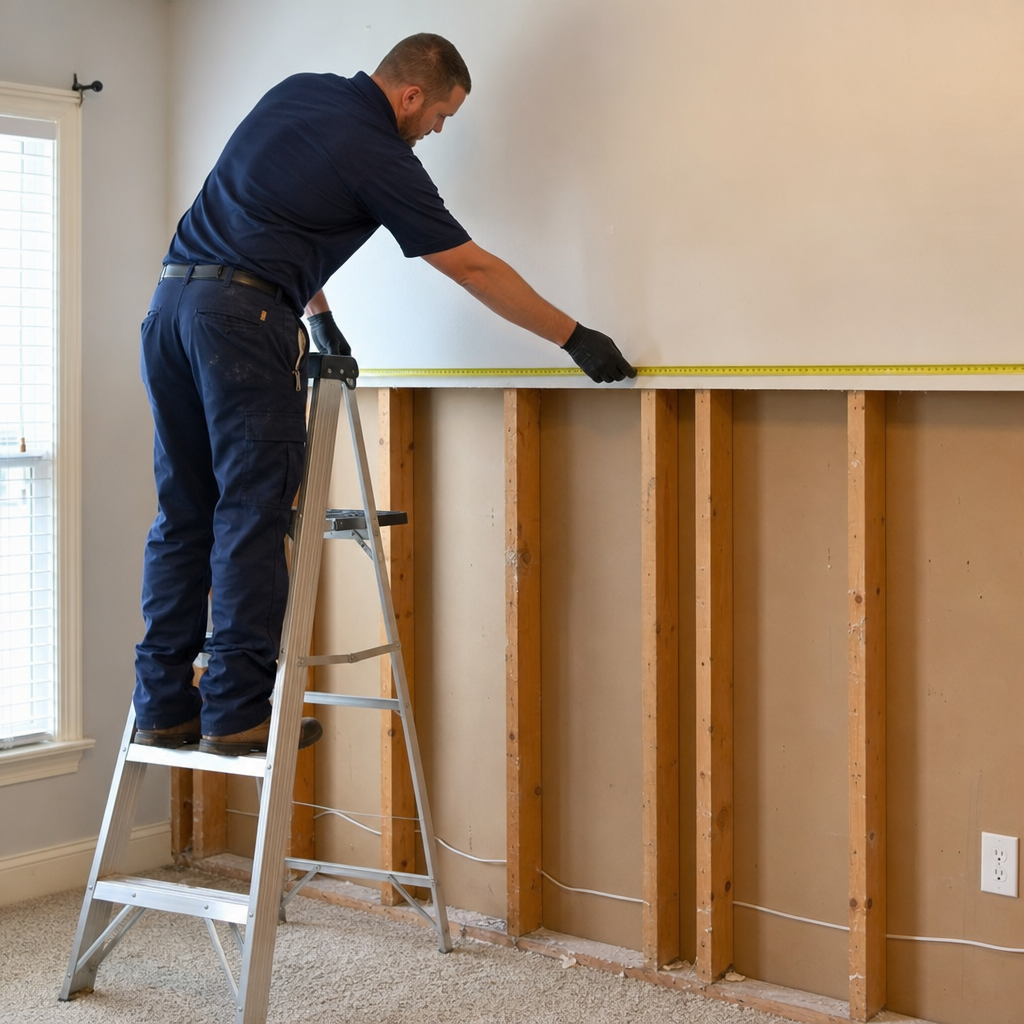
Determining whether to dry or demolish drywall comes down to structural integrity, water category, and exposure time. Wet or visibly moldy drywall should be removed and replaced, while only localized clean and dry sections may sometimes be saved. If sheetrock has been submerged for more than a day, the interior gypsum crumbles and loses its load-bearing density, meaning it must be cut out and discarded.
Assessing Sheetrock Integrity
Floodline Restoration Co. technicians inspect affected sections to check for delamination, soft spots, and swelling. Wet or visibly moldy drywall should be removed and replaced, whereas localized clean and dry sections may sometimes be preserved if structural integrity remains intact. If the paper backing shows black speckling or the board deflects under light thumb pressure, replacement is necessary.
Ceilings, Insulation, and Framing Concerns
Ceiling drywall exposed to overhead leaks presents a direct collapse hazard. Wet plaster and sheetrock gain substantial weight, pulling away from ceiling joist screws and risking sudden failure. Behind both walls and ceilings, fiberglass and cellulose insulation act like wet blankets against the wood framing. Saturated insulation cannot be dried effectively inside a closed wall; it must be extracted to let the underlying studs dry out completely.
The Risk of Standard 2-Foot Flood Cuts in Bergenfield Split-Levels and Cape Cods
A common mistake during local flood repairs is making a standard two-foot flood cut from the floor. In Bergenfield’s split-level and Cape Cod homes, construction quirks like fire-blocking, staggered framing, and retrofit vapor barriers trap moisture higher up the wall cavity.
Capillary action frequently pulls water three to four feet upward through older, porous insulation. Cutting only two feet leaves wet fiberglass hidden higher in the stud bay, where it rots sill plates and feeds mold behind baseboards. Restoration technicians from Floodline Restoration Co. use deep-probe moisture meters to establish the true moisture line before cutting, ensuring every trace of damp insulation is removed.
When Bergenfield homeowner Howard C. faced a supply-line break that soaked the finished basement of his split-level home, moisture had traveled past the lower sheetrock into the upper ceiling cavity. PDQ Fire Water Damage removed the damaged lower panels, extracted wet rockwool insulation, and ran commercial desiccant dehumidifiers with daily moisture tracking for five days, drying the framing to safe equilibrium before hanging fresh, mold-resistant drywall.[2]
Frequently Asked Questions About Bergenfield Drywall Repair
How much does it cost to repair water damaged drywall in Bergenfield?
Minor patches and localized surface repairs run between $150 and $800. Larger jobs involving multi-room extraction, insulation removal, cavity drying, and new sheetrock installation generally run from $800 to $1,500 or higher depending on the square footage.
How quickly can professionals respond to emergency drywall water damage in Bergenfield?
Emergency mitigation crews located in Bergen County can be dispatched promptly to assess damage, stop active leaks, and begin water extraction.
Does homeowner insurance cover drywall water damage restoration?
Yes, if the source is sudden and internal, such as a burst pipe, frozen line, or appliance overflow. Damage from long-term unresolved leaks or groundwater flooding from outside typically requires separate endorsements or specific flood policies.
How do professionals check for hidden mold behind wet drywall?
Restoration technicians at Floodline Restoration Co. use non-destructive thermal imaging cameras to locate cold moisture pockets, pin-type meters to measure deep wood framing moisture, and small borescopes to inspect the interior of closed wall cavities without tearing down good drywall.
What steps are involved in drying and restoring water-damaged walls and ceilings?
The restoration process follows five distinct steps: source inspection and moisture mapping, water extraction, precision removal of unsalvageable drywall and insulation, high-velocity structural drying with air movers and dehumidifiers, and final reconstruction, which includes hanging, taping, sanding, and painting new sheetrock.
Need drywall water damage repair in Bergenfield?
We’re available now - call for a fast, free estimate.
Sources
Related reading: Ceiling Water Damage Repair in Teaneck | 10% Off & Free Estimate | On-Site in 60 Minutes
Related reading: Water Damage Restoration in Bergenfield – Call Now-10% Off – Same-Day Service – Free Estimate
Related reading: Water Damage Restoration in Teterboro | 10% Off & Free Estimate | Same-Day Service
Frequently Asked Questions
How long does structural drying take before new drywall can be installed in Bergenfield?
Structural cavity drying typically takes 3 to 5 days using industrial dehumidifiers and air movers to return internal framing to safe moisture equilibrium. Floodline Restoration Co. verifies that wood framing and sill plates are completely dry using thermal imaging and moisture meters before hanging fresh sheetrock.
Why is cosmetic drywall patching dangerous after an indoor water leak?
Applying spackle or paint over water stains seals trapped moisture inside closed wall bays, accelerating wood rot and mold development within 24 to 48 hours. Floodline Restoration Co. avoids recurring structural issues by establishing containment, mapping hidden wet zones, and removing soaked insulation before completing seamless drywall repairs.
Does Floodline Restoration Co. handle both the water mitigation and final drywall reconstruction?
Yes, Floodline Restoration Co. provides end-to-end service by managing moisture extraction, structural cavity drying, insulation replacement, and flawless sheetrock reconstruction under one certified team. Bergenfield residents can call 24/7 for immediate emergency dispatch or schedule a free on-site visual moisture inspection.
About the author
 |
Christopher Vance Christopher Vance brings over 12 years of hands-on experience in water mitigation and structural drying to the Floodline Restoration team. Holding IICRC certifications in Water Damage Restoration (WRT) and Applied Structural Drying (ASD), he specializes in rapid response strategies for Teaneck properties affected by severe water intrusion. His background in construction management from Rutgers University allows him to provide clear, actionable advice on minimizing secondary damage and navigating the restoration process. |
Water damage, flood, or mold emergency?
We’re available now - call for a fast, free estimate.
Call Now - Free Estimate